
Machine Learning for C# Developers Made Easy
How to get into machine learning as a C# developer and why would you want to.

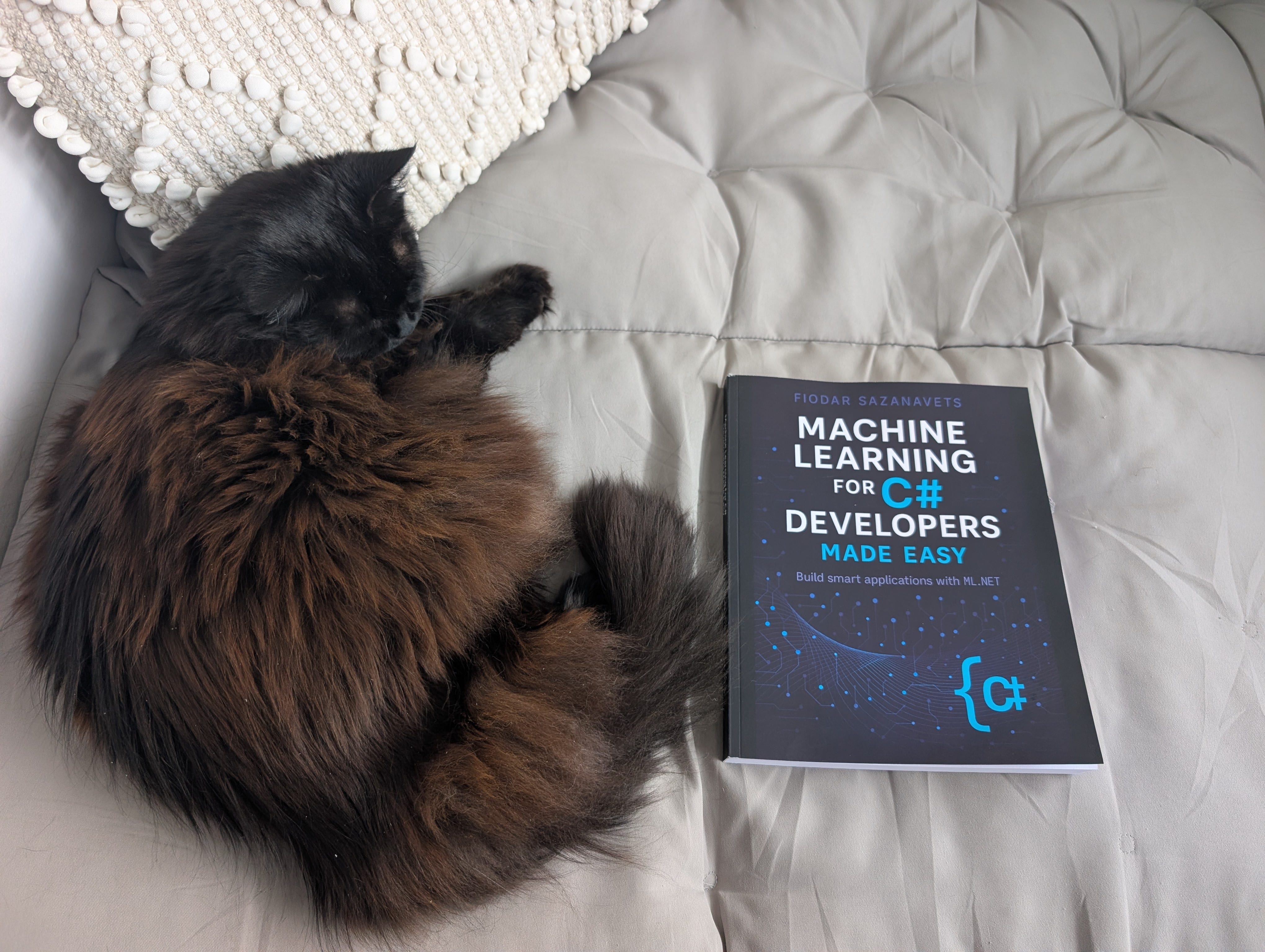
If you’ve been following me for a while, you would know that I wrote several books related to .NET and C#. Most recently, I published a book on machine learning using ML.NET.
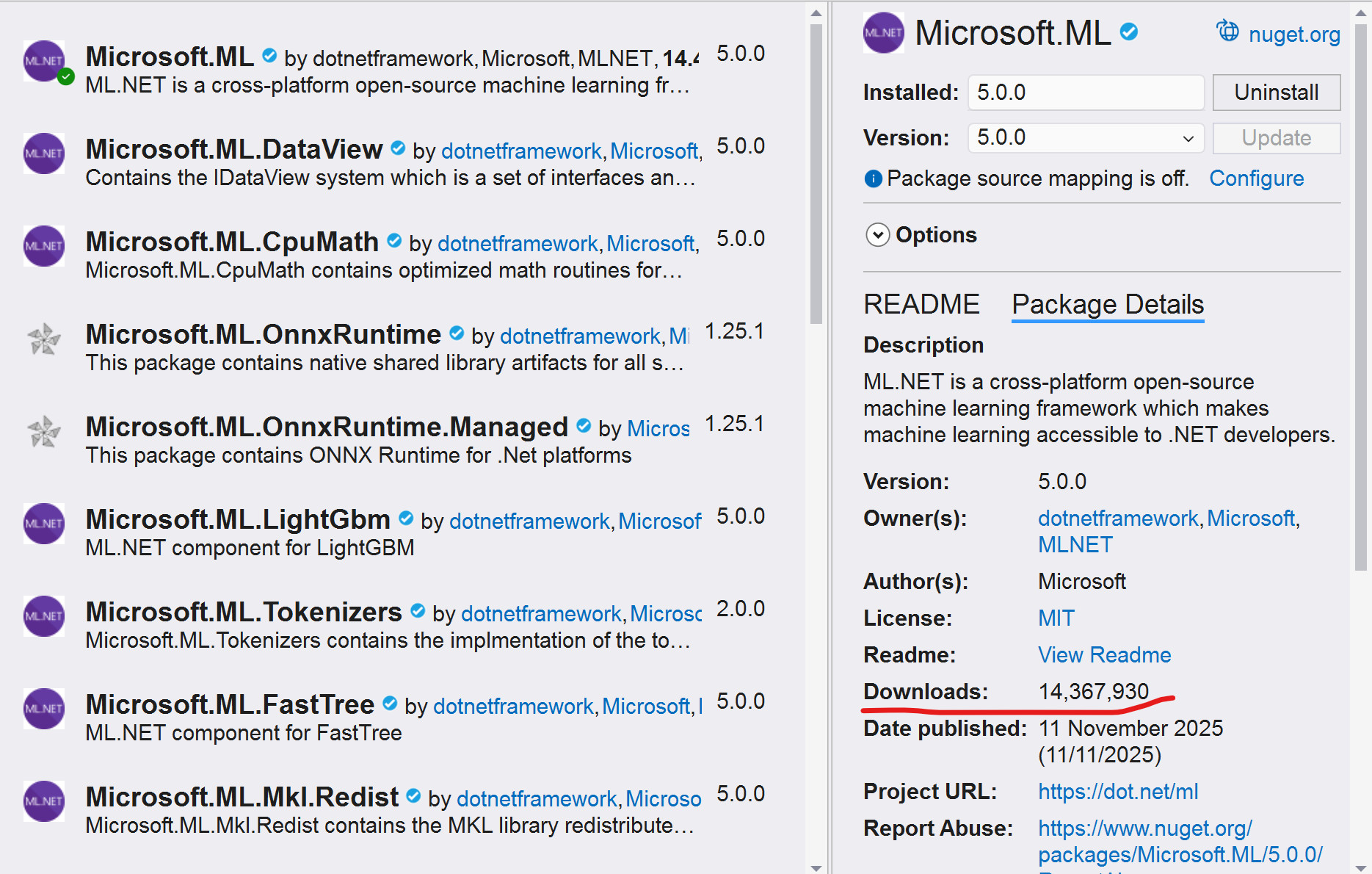
I wrote this book because ML.NET is a subject that deserves much more attention than it currently gets. Not enough people are talking about it on .NET forums, while the technology is actually quite popular. Its core library, Microsoft.ML, has over 14 million downloads on NuGet:
It’s also used a lot by internal machine learning tools at Microsoft. If you can think of any machine learning service on Azure, chances are, ML.NET is used there somewhere. Moreover, ML.NET is notably used by Microsoft for its facility management at its Redmond campus.
But there’s one particular thing about ML.NET that makes it stand out over anything. It explains why I gave my book the title that I gave it, Machine Learning for C# Developers Made Easy. It really does make machine learning easy, even if you have no prior machine learning or data science experience at all! Here’s how:
It comes with a handy CLI tool,
mlnet, which trains multiple training algorithms with different parameters. You don’t have to micromanage the training process. You don’t even need to know anything about the training algorithms and their parameters. ML.NET will try multiple algorithms and select the best one for you based on its evaluation metricsAll you have to learn is just the most fundamental and simplest machine learning concepts, such as these:
The difference between a feature and a label
What different ML tasks are for (e.g., classification, regression, forecasting, etc.)
And that’s about it to get started!
Most importantly, you won’t have to learn Python!
Yes, you read it right! ML.NET is built entirely in .NET and C#. While it can interoperate with Python models, the actual code is written in C#.
However, an important question that you may ask is what benefit is there to learning ML if large language models are everywhere and you can just use those? Well, there are some notable advantages you can gain. Let’s talk about them.
Why would you need to know machine learning in the age of LLMs
LLMs are not a replacement for machine learning; they are one very powerful kind of machine learning model. A developer who understands ML can use LLMs better, know when not to use them, and build systems that go beyond prompting.
A developer should still learn ML for five big reasons:
1. Most business ML problems are not “chat” problems
LLMs are great for language, reasoning-like workflows, code, summarization, extraction, and assistants. But many production problems are still classic ML problems, like classification, anomaly detection, forecasting, etc.
ML libraries and frameworks, such as ML.NET, still center on classification, regression, clustering, dimensionality reduction, model selection, preprocessing, metrics, and anomaly/novelty detection, because those are still core production tasks.
2. LLMs need ML thinking around them
Modern LLM applications still depend on ML concepts:
RAG needs embeddings, vector similarity, ranking, recall, precision, chunking, evaluation, and data quality.
Fine-tuning needs training data, validation sets, overfitting awareness, loss, metrics, and model comparison.
LLM evaluation needs test sets, ground truth, confusion matrices, precision/recall trade-offs, and error analysis.
In other words, a developer who only knows “prompting” can build demos. A developer who knows ML can build reliable AI systems.
3. Classic ML is often cheaper, faster, and easier to control
For many structured-data problems, a small regression model, decision tree, gradient-boosted model, or anomaly detector may be faster than an LLM, cheaper to run, easier to explain, easier to test, easier to deploy at the edge, and less likely to produce unpredictable natural-language output.
For example, predicting whether a transaction is suspicious does not necessarily need a 100B-parameter model. It may need a well-trained classifier, good features, robust monitoring, and clear thresholds.
4. ML knowledge helps you judge LLM claims critically
Developers increasingly need to answer questions like:
“Is this model actually better, or did we just cherry-pick examples?”
“Are we leaking test data into training?”
“What metric matters: accuracy, recall, precision, F1, latency, cost, or user satisfaction?”
“What happens when the data distribution changes?”
“Can we explain this decision to a customer, auditor, or regulator?”
NIST’s AI Risk Management Framework emphasizes that AI risks can change in real-world deployment and that opacity, limited explainability, and lack of transparency can complicate risk measurement. That is exactly where ML literacy matters.
5. It makes you more valuable as a software engineer
A developer who understands ML can bridge the gap between data scientists and production engineering. They can help with model serving, API design, data pipelines, feature engineering, evaluation harnesses, monitoring, drift detection, privacy/security concerns, MLOps, and cost optimization.
That is especially valuable now because many companies are moving from “AI experiments” to “AI systems that must actually work.”
The key point: LLMs reduce the amount of ML you need to implement from scratch, but they increase the value of understanding ML well enough to choose, evaluate, integrate, and govern models.
A good modern developer does not need to become a research scientist. But learning practical ML is still very worthwhile. It turns you from someone who can call an AI API into someone who can design dependable intelligent systems. And if you want to be an AI engineer, knowing ML is absolutely crucial.
What my book will teach you
The book provides a structured, hands-on guide on how to train your own models and build your own AI applications, so you don’t just learn the theory, but strengthen your knowledge with practice. It starts by explaining what ML.NET is, what it’s used for in the wild, and how it acts as a gateway into machine learning for C# developers.
Then, we cover the machine learning fundamentals. We don’t go too deep. After all, it’s not a PhD-level data science book, and we aren’t studying for a PhD in data science. We just cover enough of these fundamentals that, when we talk about specific machine learning tasks, those make sense to you.
Then, we cover the process of selecting an appropriate ML task for the problem. You will learn what types of tasks ML (and ML.NET in particular) can learn to perform, and what defines those tasks. This is a very important part that is often overlooked, because it matters not only that you know how to use ML models, but when to use what models.
After that, you will get your hands dirty by building your own virtual assistant. You will train models to perform classification, product recommendations, price comparison, and future forecasting. You will integrate these models into a .NET application that will act as a multi-purpose virtual assistant.
You will then extend the assistant with unsupervised learning capabilities. This is when the model isn’t pre-trained with any labelled data. The model looks at the data, makes sense of it on its own, and figures out the patterns. In our example, you will get an assistant to group property listings based on common features, such as the area, number of bedrooms, price, etc. Then, we will add the ability to detect anomalies in system logs, which was based on an actual project I have been part of.
We then move on to something more complicated: deep learning and natural language processing. These are the things that any language models rely on, including the LLMs. This is why it’s important to know these subjects, at least, at a high level. You will practice these concepts by turning the interface for your virtual assistant app into a chatbot-like feature.
After this, you will learn yet another deep learning functionality: computer vision. You will build features that can classify images and detect objects in images! If you ever wondered how facial recognition works, that’s the starting point.
Then, we will finish off by talking about the Model Builder tool in Visual Studio, how AutoML makes automated training possible, and how to convert models between different formats. ML.NET has its own ML model format. However, it’s designed to interoperate with other ML frameworks. Natively, it can convert its model to and from the universal ONNX format. With the help of additional libraries, it can also work with PyTorch and TensorFlow models, which are very widely used in the Python ML ecosystem.
And yes, you will be able to do all of this without learning Python!
Where to get this book
If you are intrigued, here’s where you can get your copy of this book:
It’s also available in many other countries on Amazon, so look out for it to see if it’s available in yours.
And if you found it useful, don’t forget to leave a review. This will help make the book more discoverable, so more .NET developers can get into machine learning.